APS Mission Statement: The American Polar Society has since 1934 united people and institutions from around the globe and pole to pole to appreciate, celebrate, and further knowledge and understanding of the Arctic and Antarctic land, sea, and ice.
Table of Contents
- Message from the President
- Call for Volunteers and Thank you Members!
- United States 250th Anniversary
- Recap of Perspectives on the Arctic Event
- Announcing the International Polar History Year in 2028
- Appreciation for the USS/USCGC Glacier
- New Icebreakers Making Progress
- Past and Present of One Antarctic Peak
- Movie Review: The Flight of the Eagle
- In the News
- Build on the Past … but get with The Polar Times
Message from the President

Dear Members and Friends of The American Polar Society,
A very warm welcome to our new members—and thank you to everyone who continues to support the American Polar Society. We are delighted to say that we are growing! Our renewed efforts to connect with people who share a passion for the polar regions are bringing new energy and new faces to our 90-year-old organization. If you are receiving this issue of Voices from the Ice, you are either a member of the Society, someone who has expressed an interest in our work, or someone who has been forwarded this newsletter by a friend. That is why we are pleased to address you as our Members and Friends of APS.
Your interest and encouragement inspire us to keep expanding our efforts. With our first symposium in many years now behind us, planning is already underway for the next one. We are also preparing another season of Voices from the Ice – Live, our social media interview series featuring fascinating conversations with people living and working in the polar regions. You can watch our interviews on the APS YouTube channel.
As a volunteer-powered and member-funded organization, APS relies entirely on the generosity of our members and supporters. To continue promoting and supporting the polar regions through science, environmental stewardship, culture, education, and public engagement, we need your help. We invite you to consider making a donation or joining us as a member. Membership information can be found below.
And if you have talents or services you would like to share, please reach out to me at info@americanpolar.org. We are currently seeking assistance from a lawyer and a webmaster, and we are always eager to hear your stories and experiences from your time on the ice. Thank you for being part of our growing polar community. Enjoy this issue of Voices from the Ice and check out our website to see our previous editions. We look forward to learning more about your interest in the polar regions and hope you will continue this journey with us.
Warm regards,
Susan Adie
President, American Polar Society
Thank you, Members! Volunteers Needed!
It is with deep gratitude that we thank all members of The American Polar Society. As an all volunteer organization, we would not exist without you contributing your time and money.
- Website Guru: We are looking for an internet savvy individual to help us maintain and expand our web page and to work with our social media expert to increase the effectiveness of our online outreach.
- Legal Advisor: We are looking for someone to help us answer basic but important legal questions that we as a non-profit must answer.
If any of these sound like a perfect opportunity to you, please reach out to us on info@americanpolar.org.
Also, we would like to partner with more organizations to enhance education in and encourage involvement with polar communities of science, culture, government, and education. If you are connected with an organization you think would be open to discussing future lecture series or symposia, please drop us a note at info@americanploar.org.
Happy 250th Birthday, United States of America!
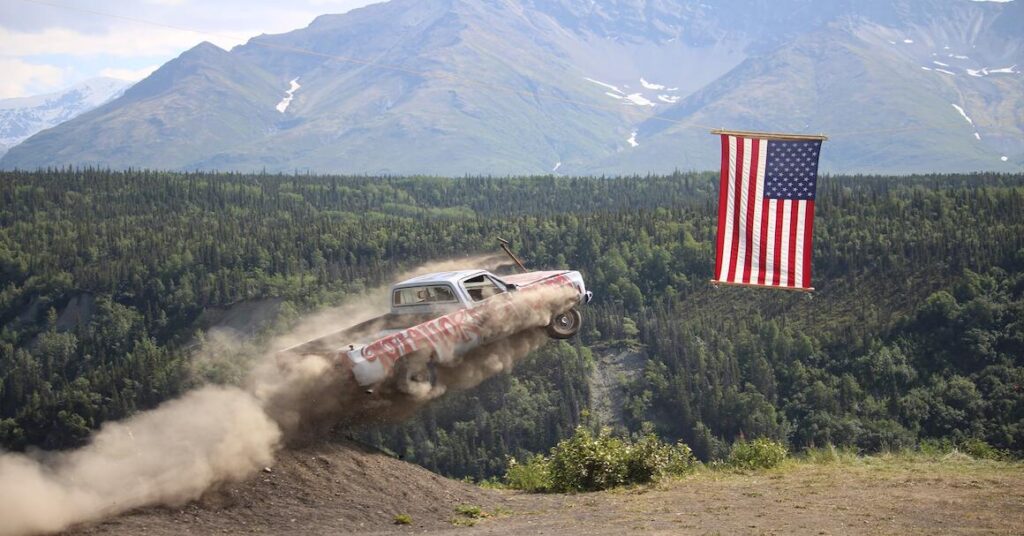
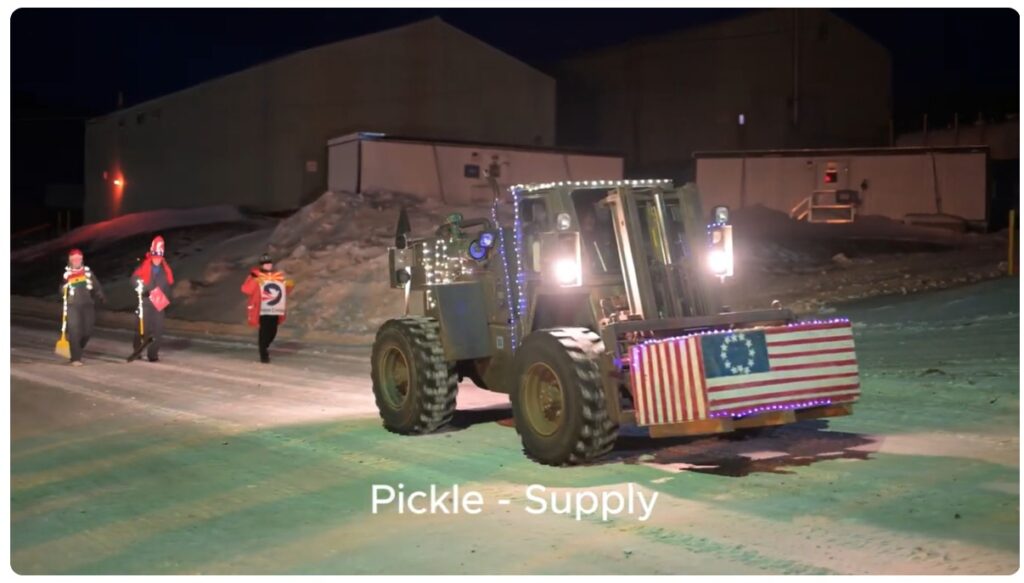
We trust everyone reading this had a safe and enjoyable July 4 celebrating 250 years of the United States of America being an independent nation! Here is our favorite line from the Declaration of Independence, “We hold these truths to be self-evident, that all men are created equal, that they are endowed by their Creator with certain unalienable Rights, that among these are Life, Liberty and the pursuit of Happiness.” And in pursuit of that last Right, here are two of our favorite polar celebrations of the big day: the launching of junk cars off a cliff in Glacier View, Alaska (since the summer sky in Alaska doesn’t get fully dark for fireworks this time of year) and what is likely the world’s coldest 4th of July parade organized by the members of the Antarctic Fire Department and Recreation located at McMurdo Station.
Recap of Perspectives on the Arctic Event
The APS was pleased to hold on May 7 a public event entitled, Perspectives on the Arctic: Then and Now. The event, held in collaboration with the Elisha Kent Kane Historical Society in the iconic Kane-Peary-Byrd Room, a polar exhibition showcase in midtown Manhattan, included a presentation by author Sheldon Bart (Race to the Top of the World: Richard Byrd and the First Flight to the North Pole) and a discussion of 21st century strategic challenges in the Arctic by policy experts former U.S. Homeland Security Advisor Julia Nesheiwat, Ph.D. and former Alaska Lieutenant Governor Mead Treadwell (pictured to the left), as well as the U.S. State Department’s former lead polar negotiator Raymond V. Arnaudo, Arctic policy scholar Captain Lawson W. Brigham, USCG (Ret.), Ph.D., and non-resident CSIS senior associate William Muntean. If you were not able to attend in person or view it live, you can still watch it on the APS YouTube channel.

Announcing the International Polar History Year in 2028
Between 1999 and 2001, a traveling, immersive museum show about Sir Ernest Shackleton and the Endurance saga captured the public imagination. New books appeared on the subject and old accounts were reprinted. Shackleton’s leadership principles became mass-market fare. Feature films and documentaries were produced. Anything pertaining to “ice” was suddenly saleable. Then “Shackleton Mania” subsided, and once again the amazing, true stories of the explorers who sought to extend our knowledge of the Arctic and Antarctic were eclipsed by what can only be described as historical amnesia.
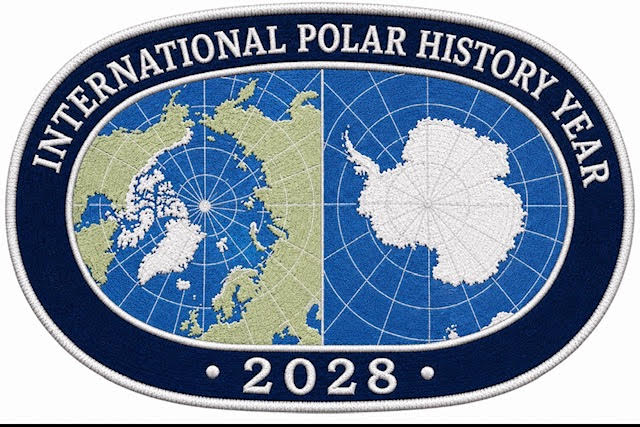
To revive and celebrate the incredible exploits of the heroic figures who challenged the polar regions north and south in wooden ships and early airplanes, and with dog sleds and dirigibles, 2028 has been designated the first International Polar History Year (IPHY). The IPHY Steering Committee said the following in an initial announcement:
“The great Roald Amundsen, first to set foot on the South Pole, navigate the Northwest and Northeast Passages and fly from Svalbard to Alaska by way of the North Pole, died on or about June 18, 1928, en route to the Pole on a search-and-rescue mission. Richard Byrd and Sir Hubert Wilkins embarked later that year on landmark Antarctic expeditions. We anticipate for 2028 a worldwide series of exhibitions, symposia, observances, and educational presentations commemorating the polar travels of Amundsen, Byrd, Wilkins and their contemporaries, and those who broke trail for them.”
Further details will be available at https://www.iphy.news/.
Appreciation for the USS/USCGC Glacier
The APS Voices team recently had the opportunity to learn about the storied history of the USS / USCGC Glacier from Peter Hutchinson, LCDR USN (Ret.). The Glacier has both the USS and USCGC prefix since it was in operation in the U.S. Navy from its commissioning in 1955 to 1966 and with the U.S. Coast Guard from 1966 to its decommissioning in 1987 when that service assumed responsibilities for all icebreaking activities. The Glacier operated in both the Arctic and Antarctic regions, including serving as the flag ship for Rear Admiral Richard E. Byrd during the first Operation Deep Freeze from 1955 to 1956. The Glacier continued to operate in the polar regions, including during the International Geophysical Year (1957 to 1958) when the United States and eleven other countries demonstrated the success of international scientific cooperation in Antarctica, which led to the Antarctic Treaty that still governs the region.
LCDR Hutchinson described to APS his experience on the Glacier in Antarctica and its Southern Ocean during his 1960 to 1962 cruise. The primary task of the Glacier, as it is for its successor, the USCGC Polar Star, is to break a channel in the Ross Sea so supply ships can access the U.S. McMurdo Station. As he said, “You have to break a channel through ice 4 and 5 feet thick for regular ships. That can take days if the ice is thick enough. Even for an icebreaker it can be challenging. We helped supply ships make the 15 mile trip, working through snowstorms and winds of over 50 knots. Our skipper, experienced in working through ice, developed a technique where we headed the ship to the left, then to the right. Its heaviness broke the ice and then provided a space for it to go, making a zig-zag progress.”
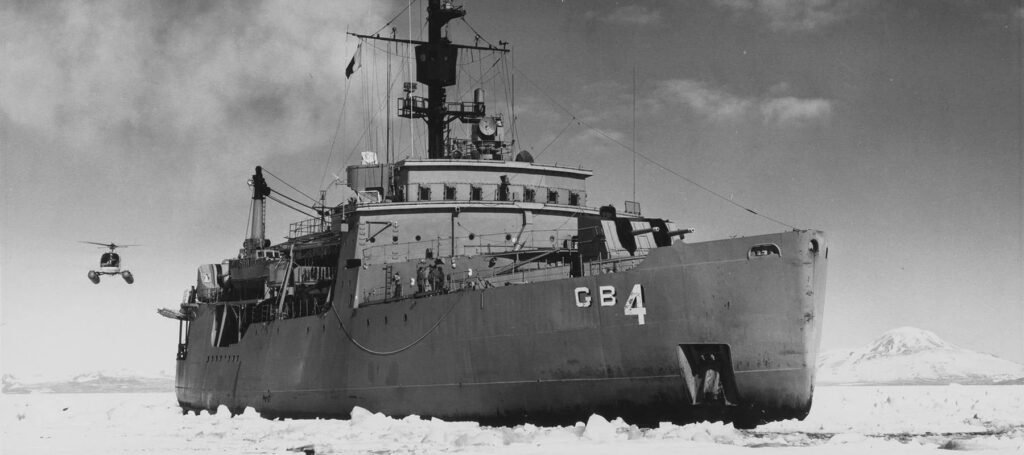
Photo from US Naval Institute
LCDR Hutchinson described flying in a helicopter to plot and map the Saunders Coast of Marie Byrd Land, exploring an ice cave on a hill that one could enter and look down a crevasse hundreds of feet deep, and following the ridge of a crevasse until it became too narrow to proceed. He also described how the ship would support scientists and crew on land, including one time when a group had to stay two nights due to a sudden snowstorm and how one of the crew saved lives with his knowledge of building a snow hut.
Of course, LCDR Hutchinson commented on the infamous Drake’s Passage, where he said, “the wind would get from 55 to 70 knots and the temperature to some 22 degrees below zero!” He also recounted an incident in the Bellinghausen Sea when the new captain was thrown out of his bunk onto the floor and suffered fifteen stitches to his forehead. Throughout his travels, he was particularly impressed by the petrels and albatross, Adelie and Emperor Penguins, Ross Seals on the ice, Humpback and Orca (killer) whales, and ice, including a five miles long iceberg.
For those who want to learn more about this history, please see LCDR Hutchinson’s piece for the US Naval Institute’s Naval History Journal and The Glacier Society, which provides a fascinating history of the “free world’s most powerful icebreaker”.
New Icebreakers Making Progress
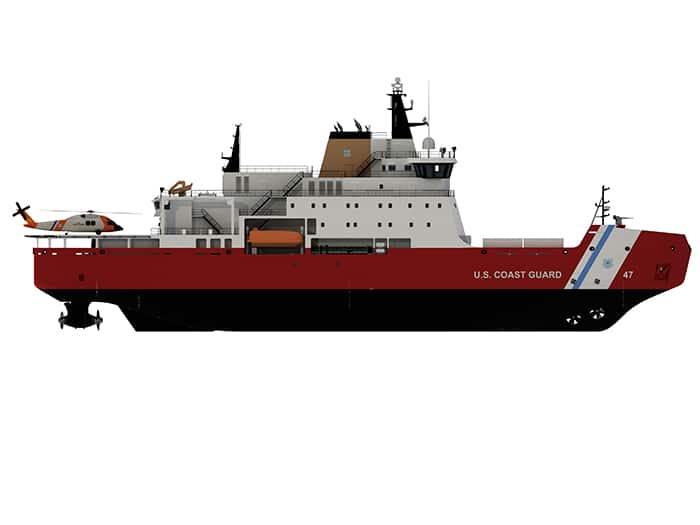
Continuing with the icebreaker theme, the U.S. Coast Guard announced it had finalized a multi-billion contract to build six new icebreakers, with the first expected in 2028 and all six by 2031. Additionally, the U.S. Coast Guard named Kodiak and Seward, Alaska as the homeports for three future Arctic Security Cutters that will be built under the ICE Pact between Canada, Finland, and the United States. This is particularly timely progress as China is reportedly sending four scientific vessels to operate in Arctic waters from July to October. (Image from MarineLog)
Past and Present of One Antarctic Peak
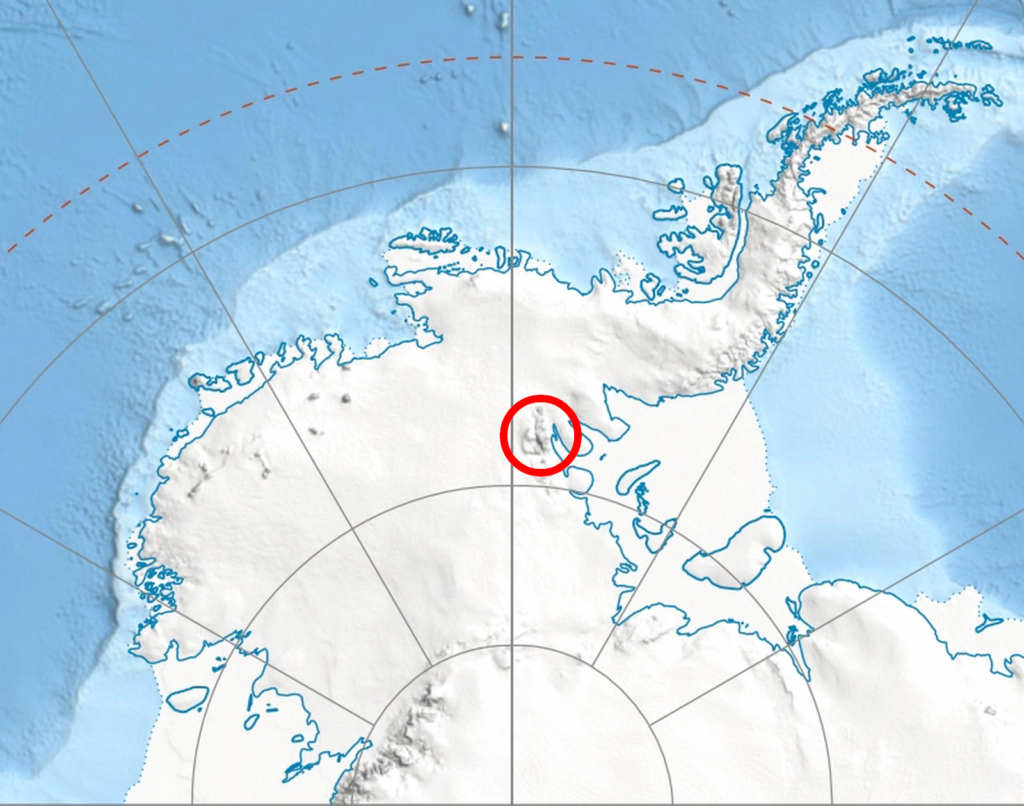
The APS Voices team also had the opportunity to talk with University of Minnesota assistant professor of glaciology, Dr. Peter Neff, about a time he learned the personal backstory of an Antarctic place name. Dr. Neff described meeting the nephew of U.S. Navy aviation electronics technician, Charles S. Miller, who was killed in a crash of a P2V Neptune airplane at McMurdo Sound on October 18, 1956. The naval aviators were the vanguard of U.S. research conducted during the International Geophysical Year. The nephew, Ethan Robison, shared memories and photos of Miller and his work as part of U.S. efforts to preserve Antarctica for peace and science. In addition to being remembered by his family, the Advisory Committee on Antarctic Names (ACAN) and the U.S. Board on Geographic Names agreed to memorialize Charles Miller and his fellow fallen naval aviators by naming a peak in the Sentinel Range in the Ellsworth Mountains, Antarctica after him.
This interaction spurred Dr. Neff to research the crash and to post in 2020 the story on TikTok, which was just then reaching the heights of its social media influence. Dr. Neff admits to being nervous about that post since he was at that time relatively new to social media and due to the nature of the topic. However, as @Icy_Pete, Dr. Neff continues to post information about Antarctica and polar science via Twitter, TikTok, and Instagram. His success at science communication led Columbia University to interview him about how to use social media to inform people about polar science. His advice is to know what your message will be and to post something catchy (and you never know what will be catchy) as the vehicle to relay that message.
Movie Review: The Eagle Soars
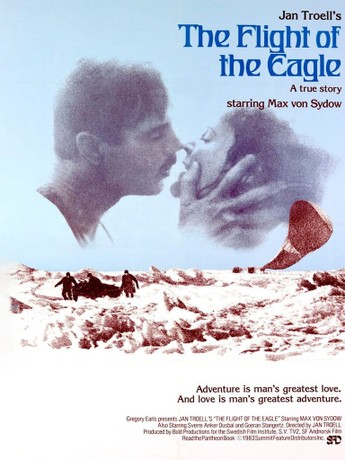
Throughout much of the 1982 film, The Flight of the Eagle, Max von Sydow portrays the Swedish engineer and Arctic explorer Salomon August Andrée as a stoic, detached Mr. Spock-like figure.
Andrée and two companions departed in a hydrogen-filled balloon from Danes Island off the northwest coast of Spitsbergen in July of 1897 with the intention of soaring to the North Pole. However, they lost a couple of drag ropes on takeoff, their principal steering mechanism. Adrift in gale-force winds, they eventually came down on the ice and attempted to man-haul to safety. Their bodies were recovered on White Island, the easternmost island in the Svalbard group, thirty-three years later.
Filmmaker Jan Troell recreates the run-up to the flight and the survival ordeal in brilliant detail, incorporating diaries and photographs retrieved from the explorers’ last camp. But it is in the latter stages of the saga that the Eagle really soars. The director, the screenwriters, and particularly the supremely gifted von Sydow manage to expose the psychology of the protagonist, an inexperienced aeronaut confidently deflecting criticisms and misgivings.
Beneath the veneer of a graduate of the Vulcan Science Academy, Andrée ultimately emerges as all too human.
In the News …
The International Union for Conservation of Nature announced in April that Antarctic fur seals have joined the Emperor Penguin as being Endangered species. Despite this concerning news, the annual Antarctic Treaty meeting held in May did not provide additional protections to either species. On the same troubling theme but in the north, the Arctic Council Secretariat reported in April that thousands of seabirds, such as puffins, died in winter storms in incidents called “wrecks”. Climate change is cited as a contributing cause for all of these losses.
The first of 10 drifts over the next 20 years in the Arctic Ocean will start in September. The Tara Polar Station, which will hold 12 people, will freeze itself into the Arctic ice to conduct scientific research in this rapidly changing and little known region.
Scientists in the north are researching the Arctic Ocean now that it is easier to reach the geographic North Pole due to the 40% reduction in sea ice since the 1970s. In the south, scientists have a new explanation about why the Antarctic ice sheets developed millions of years before the northern polar ice cap.
Build on the Past … but get with The Polar Times
Join the American Polar Society to receive our flagship publication, The Polar Times. It is our hard-copy journal that prints articles from scientists, historians, artists, writers, explorers, and support personnel covering past, present and future happenings in both the Arctic and Antarctic.
The American Polar Society has since 1934 united people and institutions from around the globe and pole to pole to further knowledge, understanding, appreciation, and celebration of the Arctic and Antarctic land, oceans, and ice.
Members today come to us from the four corners of the Earth and all walks of life! Anyone who has lived, worked, or explored the ice—or merely read and dreamt about it—are welcome to join and become engaged. Our continuing success is based on everyone’s contribution.
Projects we look forward to in our next decade:
- Podcasts
- Virtual presentations
- Live symposia
- Honoring polar pioneers
You can join by visiting our website (americanpolar.org) or by completing and submitting the form below. Please be sure to provide an email address when joining so we can stay in touch!