APS Mission Statement: The American Polar Society has since 1934 united people and institutions from around the globe and pole to pole to appreciate, celebrate, and further knowledge and understanding of the Arctic and Antarctic land, sea, and ice.
Hello Friends and Members of the American Polar Society!
Table of Contents
● Message from the President
● Voices from the Ice LIVE!
● 20th annual Arctic Report Card
● Introducing UKAHT
● Book Review: Reluctant Conquest
● Book Reviews: Antarctica as a Model for Global Peace and Antarctica and the Earth System
● Movie Review: Beneath the Polar Sun
● Polar and Indigenous Voices for children!
● Happiness is a Polar Bear at 80 Degrees North
● In the News
● Thank you, Members! Volunteers Needed!
Message from the President
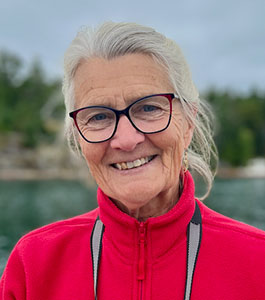
Dear Members! We hope you Kick off the New Year with good health and fun projects to look forward to!
In the Board our projects look like this:
● Continuation of one of the longest running journal focused on the polar regions; The Polar Times.
● Year Two of our newsletter – Voices from the Ice – yes, the one you are reading right now! If you have a polar story to share, reach out to us at info@americanpolar.org so you can be part of this communication!
● Social Media posts have jumped from a few likes here and there to hundreds of likes! We hope you are following along on Facebook and LinkedIn.
● New in social media – Voices from the Ice – Live! Come visit us on Facebook to see our offerings from scientists, historians and others who are reporting from the ice!
● Our Thank-A-Thon Continues! We need updated phone numbers for many Members. We heard about your time on the ice: Stephen D. shared his research in Antarctica, Jennifer R. shared some of her experiences from the Antarctic Emergency Response Team, Richard W. told us about his work with the Arctic Institute of Iceland on the 10th of ten books on the Glaciers of the World, and Akhouri S. asked for an update on APS activities. We guided him and others to the most recent journal for a report on our various actions this year. For those of you we did not find at home, we left voice messages, we emailed you and we hope that we will find you in our next effort. You can always reach out to us at info@americanpolar.org and we look forward to hearing from you!
● The newly launched Brian Shoemaking Fund has raised over $10,000 for development and support of the APS! Thank you to all for your generosity. We hope to hear from others over the next few months!
● COMING May 2026 – APS will host a mini-symposium in New York City in conjunction with the Elisha Kent Kane Historical Society. Globally recognized speakers will focus on the centennial of the pioneering Richard Byrd and Roald Amundsen North Pole flights in the relatively unknown Arctic of the early 20th Century and the strategic Arctic of the 21st.
Please visit www.americanpolar.org to join and to donate. Also, please feel free to share this newsletter in your social circles and your virtual platforms. To participate, contact us at info@americanpolar.org. Thank you for your continued support.
Susan Adie, President APS
Voices from the Ice LIVE!
We have started a new way to bring the polar regions to you and you to the polar regions via Facebook with Voices from the Ice LIVE!
Our first foray was with biologist Jamie Watts who was on the deck of a ship in the Scotia Sea, Antarctica. Our goal was to learn more about aggregations of fin whales near Elephant Island, which has a rich ecosystem due to its location on the continental shelf edge and edge of winter sea ice. Our second production was with photographer Esther Horvath, who had the privilege of being the National Geographic photographer for the modern quest to find the wreck of the Endurance in the Weddell Sea. We got to learn the behind-the-scenes trials and tribulations that ultimately resulted in successfully locating the legendary ship.
Follow the American Polar Society on Facebook to learn when the next Voices from the Ice Live! episodes will be broadcast.
20th Annual Arctic Report Card
The U.S. National Oceanic and Atmospheric Administration (NOAA) issued in December the Arctic Report Card (ARC) 2025, which provides a clear view of a region warming far faster than the rest of the planet. Along with reports on the state of the Arctic’s atmosphere, oceans, cryosphere, and tundra, this year’s report highlights major transformations underway—atlantification bringing warmer, saltier waters northward, boreal species expanding northward into Arctic ecosystems, and “rivers rusting” as thawing permafrost mobilizes iron and other metals. Across these changing landscapes, sustained observations and strong research partnerships, including those led by communities and Indigenous organizations, remain essential for understanding and adaptation.
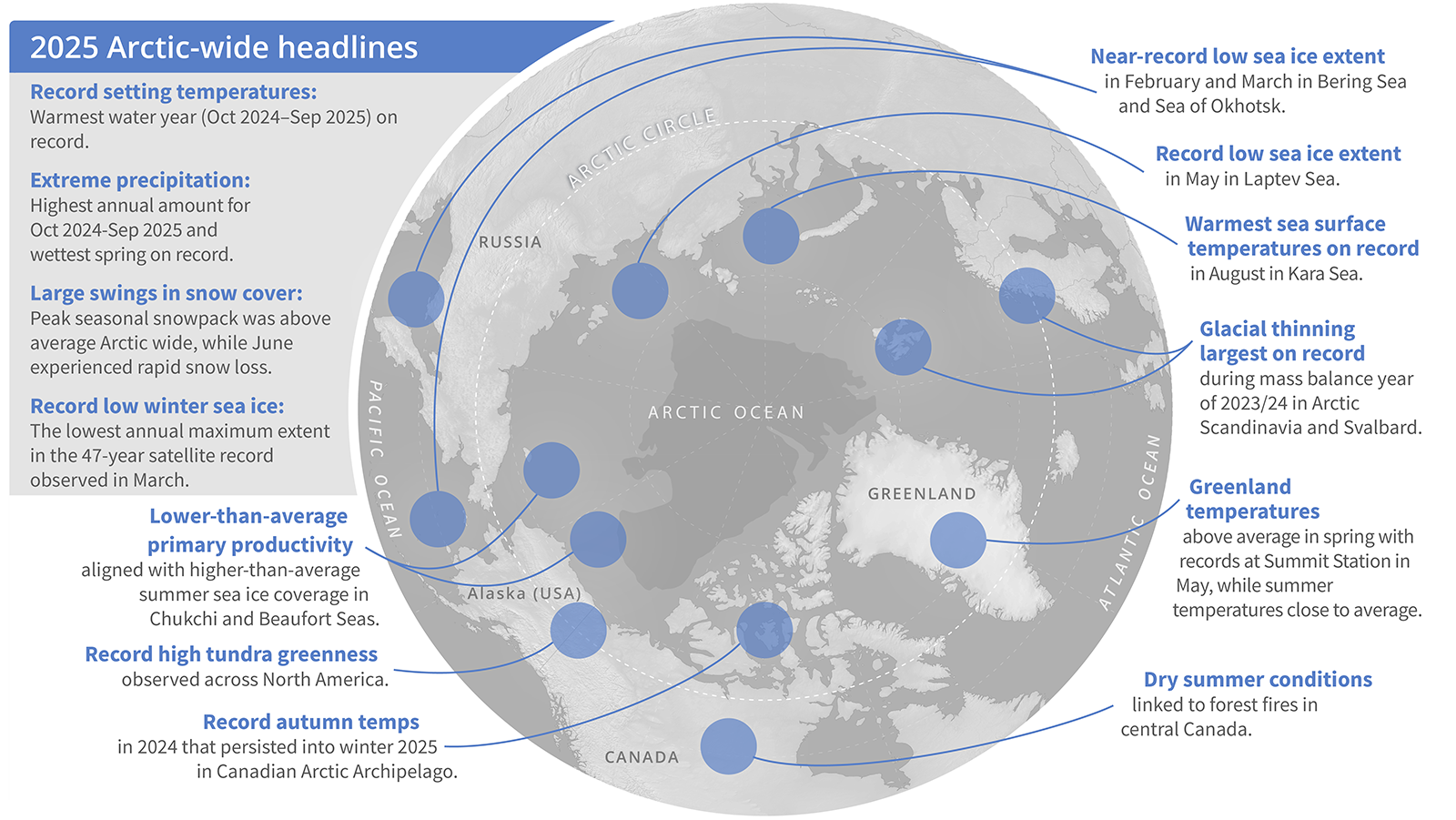
Not directly covered in the report but highly relevant are concerns that the United States will continue to reduce funding the research that underlies this and other similar reports. Reducing federally-funded research will increase reliance on indigenous-led data collection even as those communities are threatened by extreme weather events, such as the remnants of Typhoon Halong that flooded Alaska’s southwestern coast in October.
Introducing UK Antarctic Heritage Trust
UK Antarctic Heritage Trust is a non-profit preserving historic sites and artefacts of international significance in Antarctica, including the shipwreck of Shackleton’s Endurance. Each year, they send a small team to Port Lockroy on the Peninsula where they operate the world’s southernmost “penguin” post office and a museum that captures the early years of British scientific research. UKAHT deploys a specialist conservation team to carry out critical work at the sites in their care every season. Completing conservation work at almost 65° South is challenging, to say the least. Planning begins months, sometimes years, in advance. Some of the historic buildings are over 80 years old and were never designed to endure decades of brutal winds, sub-zero temperatures and the relentless freeze-thaw cycles of the Antarctic climate. UKAHT works with skilled heritage carpenters and conservators who use traditional materials and techniques.
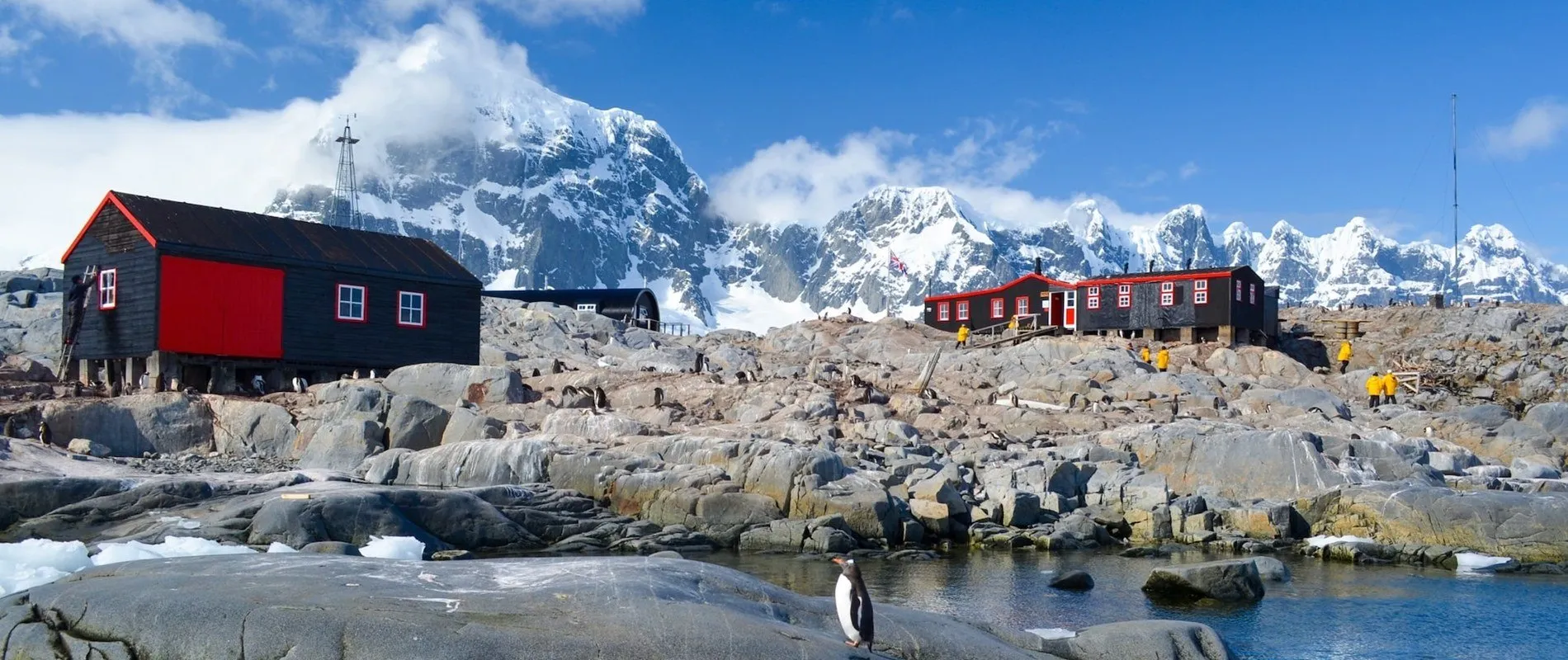
Over the next three years, UKAHT is launching an ambitious program: a major conservation effort to strengthen Port Lockroy against the growing impacts of climate change. With only 33 designated historic sites with buildings left across the entire continent of Antarctica, preserving these irreplaceable places matters to us all. Away from Antarctica, UKAHT runs events that are seen by thousands of people around the world. One recent example is called Capturing Antarctica, which explores the evolution of photography and cinematography in the region.
Book Reviews: Reluctant Conquest
Kathryn Lavelle has written a fascinating book, Reluctant Conquest: American Wealth, Power, and Science in the Arctic, which is a comprehensive study of Alaska, American relations across the circumpolar North, and our engagement and interest in the Arctic, especially our interactions with the indigenous people who lived and are living there. It starts with a history of the United States looking North in the 19th century, then moves through discussions of the history and economics of the expansion to Alaska, national security, and science that are normally treated separately. Because Alaska’s history as a state comes so much later, and remains so distinctive, most Americans do not think of their country as an Arctic power, yet it is a region where the U.S. has operated throughout its history. Reluctant Conquest is an excellent sweeping study of Alaska from the founding of the United States to the present that highlights the complex state-federal government and international relations dynamics.

Lavelle begins with the important connections among early studies of science, mapping, and navigation to the commercial interests of whaling, sealing and resource extraction and how each had profound effects on Alaskan native peoples. Continuing with the Alaska accession following the Civil War, moving through Alaskan statehood., Lavelle demonstrates her understanding of the many dimensions of the Arctic: the natural interactions between the seas, ice, and land, and the political fusion of national, international , local and Native interests. She also explains the pattern of American relations that has been contingent upon the tension between national borders that impose barriers and the need for scientific cooperation and Indigenous political participation to operate across them. In the present era, these relations work through formal institutions across a distinctive array of U.S. state, federal, and multilateral agencies, most notably the Arctic Council.
Using an approach that should appeal to readers across disciplines, Reluctant Conquest has important implications for future American policy with respect to traditional national security and political economy in addition to climate change and environmental cooperation. If you are familiar with Alaskan history and current activities there, this book will serve as a great refresher on the development of the state. If you are a novice, I can’t think of a better history and primer of modern Alaska and its role in the world.
Book Reviews: Antarctica as a Model for Global Peace and Antarctica and the Earth System

Among the many positive traits for Antarctica as a Model for Global Peace are that it is available for free in PDF and has excellent authors. Edited by Horacio Werner, Patricia Cavalcanti and Mariano Aguas, the Konrad-Adenauer-Stiftung released the book in November to provide “a compelling contemporary example of how nations can thrive through cooperation.” The book provides a useful overview of key political topics related to the southern continent and surrounding ocean with chapters on the Antarctic Treaty system, a behind-the-scenes account of the establishment of the Ross Sea Marine Protected Area from the lead U.S. negotiator, a perspective on the rise of China and growing militarization near the region, and the importance of civil society and education to maintaining Antarctica as a natural reserve, devoted to peace and science.
Another book that has similar characteristics – namely free in PDF and well-written by experts in their fields – is Antarctica and the Earth System. Edited by Michael P. Meredith, Jess Melbourne‑Thomas, Alberto C. Naveira Garabato and Marilyn Raphael. Released in April by Routledge, this book is for those who want to learn how Antarctica and the Southern Ocean influence our climate, ecosystems, economies, cultures and societies. Key chapters include atmosphere, evolution and circulation of the Southern Ocean, ice-sheet and sea-ice developments and projections, pollution and conservation, and cultural connections. The editors and authors of both books demonstrate how much learning we can achieve when we place Antarctica at the center of the map rather than off of it.
Movie Review: Beneath the Polar Sun

In 2017, polar explorer Stephen Smith brought a kayak team to northern Ellesmere Island to retrace the route of the calamitous Greely Expedition of 1881-1884. He had followed the course of Greely’s small boat journey previously in 2004. His objective the second time around was to observe changes in the sea ice. An oceanographer (a newly minted Harvard PhD) accompanied Smith, along with his wife, Diana, and two male companions. Beneath the Polar Sun (2021) is the filmed record of Smith’s 33-day Enduring Ice Expedition.
The ice, however, proved to be barely enduring. Thirteen years earlier, Smith, like Greely, had observed vast pans of ice stretching across Nares Strait, a sort of funnel between Ellesmere Island and Greenland through which the sea ice of the Arctic Ocean drifts south. Navigable leads of open water striated the channel like dark blue veins. With the break-up of the sea ice, clusters of jig-saw-shaped ice floes now clogged the Strait. The kayaks had to be portaged over the thick of it, which slowed the team down and almost put them in the position of having to relive the fate of the expedition whose route they were retracing.
The Greely party had been forced to evacuate Fort Conger, their High Arctic outpost, with rations running out and the expected relief ship having failed to arrive. They proceeded 300 nautical miles south in search of food caches that might possibly have been left for them. Out of a crew of about two dozen men, only seven survivors were ultimately retrieved. Smith and his people managed to reach a potential landing strip at Carl Ritter Bay, 60 nautical miles from the ruins of Fort Conger, their starting point. They then spent several nervous days awaiting a Twin Otter flight, with their own supplies running low.
Watch this film for truly breathtaking cinematography, but don’t take it as a model for polar travel. Smith and his Ice Expedition were lucky to have endured. They had substantial backing from Mountain Hardware, whose brand was plastered on garments and equipment throughout the full 56 minutes of the film. With that kind of support, they could have put down a couple of caches of food and provisions along their intended route before setting out for Fort Conger. They also apparently had no firearms and no bear monitor, only the foolish notion that if they spotted a polar bear, it would be spooked by the sight of humans and run away. Don’t bet on it.
Polar and Indigenous Voices for children!
If you have not taken a few minutes out of your professional life to enjoy a cartoon, might we suggest it is time to do so? Molly of Denali, found on your local PBS station, is a unique educational animation which began in 2019 and is the first nationally distributed children’s show to feature an Alaska Native as the lead character.
Not only has its 4-season run been successful. Molly of Denali has won several awards, including a Peabody Award (2020), a Children’s & Family Emmy for Outstanding Writing (2025 for the episode “Not a Mascot”), a NAMIC Vision Award (2022), and a Kidscreen Award for Best Inclusivity (2021). The series has also received multiple nominations, such as for Outstanding Children’s or Youth Programming from the Television Critics Association. However, this 5th season will be its last, as funding has been terminated since the federally sponsored ‘Ready-to-Learn Grant’ has been canceled.
Over 70 Alaska Native people have worked on Molly of Denali to represent native culture in the best manner possible. Attention is given to every component of the series by this huge team. There are various roles and responsibilities, including voice actors, writers, cultural advisors, and production staff. The production aimed for true collaboration, going beyond “tokenism”; by involving numerous Indigenous people from diverse backgrounds.
Two writers and playwrights stand out among the team. Vera Starbard is Lingít and Dena’ina, lives in Juneau Alaska, and she is currently the Alaska State Writer Laureate. She has been nominated for Outstanding Writing for a Preschool Animated Series in the episode called “Thanks-for-giving”. This is her fourth nomination for writing in this series. Another creator/contributor of note is Princess Daazhraii Johnson. She is a film maker, writer and a Sundance Film Alum, Nia Tero Storytelling Fellow, and in 2015 she was appointed by President Obama to the Board of Trustees for the Institute of American Indian Art. She is known for her work on Molly of Denali, True Detective, and Shaaghan Neekwaii (which translates into “Two Old Women”).
For more information and the opportunity to share this special program with the children in your life – go to your local PBS station to see the listings for Molly of Denali.
Happiness is a Polar Bear at 80 Degrees North
Passengers on Arctic cruise ships want to see wildlife, particularly polar bears, and were disappointed none had so far been seen. Consequently, cruise crew and expedition leaders redoubled their efforts to spot the large but elusive animals. A watch was maintained throughout the night, with two staff members each 0spending an hour on the bridge, scouting for bears, but they had no luck. However, patience has its virtues.
Approaching Moffen Island, we first saw 150-200 walruses snoozing on the beach! Each summer, walruses shed a thin layer of skin and grow new skin, and they want to slough off the old layer as quickly as possible. As they have been doing for centuries, they facilitate this process by huddling together on Moffen Island to increase their body temperature. Then, within an hour of the walrus sighting, a humpback whale suddenly appeared off the port quarter. For more than 30 minutes, the humpback “guided” the ship, surfacing repeatedly across the bow and then over on the starboard quarter. What an enthralling performance!
A little more than an hour after our close encounter with the whale, our polar bear prayers were answered in the form of a 9 1/2 foot female polar bear and a 1 1/2-year-old club about half the size of the mother walking around (Photo from Spitsbergen-Svalbard). After watching them for a bit, we excitedly ate lunch as the ship cruised several hours before anchoring in Liefdefjord. Once secure, we lowered our Zodiacs to explore the small islands off Monacobreen. Our flotilla braved choppy waters and a brisk chill, and was rewarded with sightings of five more polar bears, including another mother-cub duo and three individual bears each displaying different personalities and degrees of activity. Passengers retired in great spirits to the ship’s lounge, where the Arctic Cruise Song was sung with gusto:*

*To the tune of “I Saw the Light” by Todd Rundgren (1972)“
I saw a be-ar, I saw a bear
Now I know why I am he-re
Outside it’s freezing, but I don’t care
Praise the lo-rd, I saw a bear
In the News …
First, let’s start with some good news. According to NOAA and NASA scientists, the 2025 ozone hole is 5th smallest since 1992. As hoped and predicted, the annual ozone hole is forming later and breaking up earlier in the season. This success is due to the Montreal Protocol negotiated during the Reagan Administration to protect the stratospheric ozone layer by phasing out the production and consumption of ozone-depleting substances.
Scientists from the University of Manitoba were on the first-ever cruise by the Canadian icebreaker CCGS Amundsen to the Queen Elizabeth Islands and western Tuvaijuittuq to monitor increasingly rare Arctic sea ice. They are hoping to better understand the conditions in the Canadian Arctic, which are important for climate change, polar bears, and potential shipping lanes, among other reasons.
Speaking of ice, the 2025 State of the Cryosphere Report issued by the International Cryosphere Climate Initiative warned that maintaining our current global warming levels of 1.2°C will likely lead to several meters of sea-level rise over the coming centuries. It also warned that mountain ranges such as the Rockies would lose nearly all of their ice if there is sustained global temperatures at 2°C.
Extreme events are evolving as a direct consequence of climate change, leading to the emergence of new, previously unobserved phenomena. A recent study concluded that a rare global seismic vibration that lasted for nine days was caused by seiches (waves trapped in closed or semi-closed water) in Dixon Fjord, Greenland that occurred after two major glacier landslides.
Polar research continues to reveal the astounding and unexpected places where life occurs on Earth, in this case more than two miles below the surface of the Arctic Ocean. These gas hydrate cold seeps, which release methane gas flares, (called Freya mounds) act as “frozen reefs” for highly-adapted creatures.
Several APS Board Members published polar articles during the past three months. The Barents Observer published an opinion piece by Dr. Lawson Brigham entitled, Arctic Voyage of the Containership Istanbul Bridge and the IMO Polar Code. Dr. Brigham reports that the Istanbul Bridge operated in the Northwest (Arctic) passage even though it is unclear if it meets relevant global shipping standards. Regarding the other side of the globe, the Center for International Maritime Security published William Muntean’s article, Increase Collaboration with South America to Protect U.S. Antarctic Interests, on a short-term fix to meet U.S. national interests while starting to build the icebreakers needed.
The annual Arctic Frontiers conference will be February 2-5, 2026, in Tromsø, Norway. The conference, which has been held annually since 2007, gathers scientists, businesses, policymakers and representatives of local and indigenous peoples for holistic discussions about the future of the Arctic region.
Grade 6-12 students can connect directly with researchers aboard the RV Araon returning from Thwaites Glacier, learning how their discoveries help communities adapt to a changing climate. PBS science journalist Miles O’Brien and scientists are hosting this Antarctic Science event on Tuesday, February 10, 2026 at 10:00am Mountain Time.
Thank you, Members! Volunteers Needed!
It is with deep gratitude that we thank all members of The American Polar Society. As an all-volunteer organization, we would not exist without you contributing your time and resources.
Now may be the time in your life when you are looking for opportunities for more involvement. If so, the timing could not be better!
We are looking for members who may wish to step up to work on the Board. We are expanding the number of Board members. We ask that you commit to serving at least one term (three years), attending monthly meetings (at least 10 times per year), contributing your working knowledge or experience of the polar world with the APS and its members, and sharing a passion to support our mission.
One specific need is for a legal advisor. We ask that you have U.S. non-profit experience in addition to the above requirements.
If this sounds like a perfect opportunity to you, please reach out to us at info@americanpolar.org.